
Follow this SEO audit checklist to improve rankings, fix issues, and grow traffic with a complete step-by-step SEO audit guide for your business.
1. Introduction
If your website is not ranking on Google, the root cause almost always surfaces in a structured SEO audit. An SEO audit checklist is not just a diagnostic tool it is a repeatable operational framework that lets you systematically identify performance bottlenecks, eliminate technical debt, and align your content strategy with current search engine ranking signals.
In 2026, Google’s algorithm evaluates hundreds of on-page and off-page signals simultaneously. A site that performed well two years ago may be losing ground today due to Core Web Vitals regressions, thin content, toxic backlinks, or schema markup gaps. Without a formal SEO audit checklist, these issues accumulate silently and compound over time.
This guide provides a technically rigorous, step-by-step SEO audit checklist covering every major ranking dimension from crawlability and indexation to content depth, link equity, and local visibility. Whether you are auditing a new site or diagnosing a traffic drop, this checklist gives you a precise, actionable workflow.
2. What is an SEO Audit Checklist?
An SEO audit checklist is a structured evaluation framework used to assess every technical, on-page, off-page, and content-related factor that influences a website’s performance in organic search. It covers the full ranking stack from how search engine bots crawl and render your pages, to how well your content satisfies search intent, to the authority signals your backlink profile sends to Google.
A comprehensive SEO audit checklist is not a one-size-fits-all report. It must be calibrated to your site’s architecture, industry vertical, and competitive landscape. A large e-commerce site will prioritize faceted navigation crawl management and product schema, while a local service business will focus heavily on Google Business Profile optimization and NAP (Name, Address, Phone) consistency.
The core value of using an SEO audit checklist is repeatability. When executed at regular intervals quarterly for most sites, monthly for highly competitive niches it ensures your site adapts proactively to algorithm updates rather than reacting to ranking drops.
3. Step 1 Keyword and Content Audit
The keyword and content audit is the strategic foundation of the entire SEO audit checklist. Before addressing any technical issue, you need to verify that your content is semantically aligned with what your target audience is actually searching for.
3.1 Keyword Mapping and Intent Analysis
Start by exporting your keyword rankings from Google Search Console. Cross-reference them against your target keyword list and identify three categories: keywords where you rank in positions 1–3 (protect and optimize), keywords in positions 4–20 (high-priority improvement candidates), and keywords where you have no visibility (content gap opportunities).
For each target keyword, verify search intent alignment. A page targeting the keyword SEO audit checklist must deliver a practical, list-based resource not a sales page. Misalignment between page content and search intent is one of the leading causes of high bounce rates and poor dwell time, both of which negatively affect rankings.
3.2 On-Page Keyword Placement
Your primary keyword should appear in the following positions to signal topical relevance to crawlers:
- Title tag (within the first 60 characters)
- H1 heading (exactly once)
- First 100 words of the body content
- At least one H2 subheading
- Image alt text (where contextually relevant)
- URL slug (short and hyphenated)
- Meta description (for click-through rate, not direct ranking)
Secondary keywords such as SEO audit guide, technical SEO checklist, and on-page SEO audit should be distributed naturally across H2 and H3 subheadings and throughout the body. Avoid keyword stuffing Google’s natural language processing models penalize unnatural repetition.
3.3 Content Depth and E-E-A-T Signals
Google’s Helpful Content system and E-E-A-T (Experience, Expertise, Authoritativeness, Trustworthiness) guidelines mean thin or generic content is increasingly suppressed in rankings. Audit every page for content depth: does it comprehensively cover the topic, include original insights, cite credible sources, and demonstrate first-hand expertise? Pages that fail this standard should be expanded, consolidated with similar content, or removed from the index.
4. Step 2 Technical SEO Audit
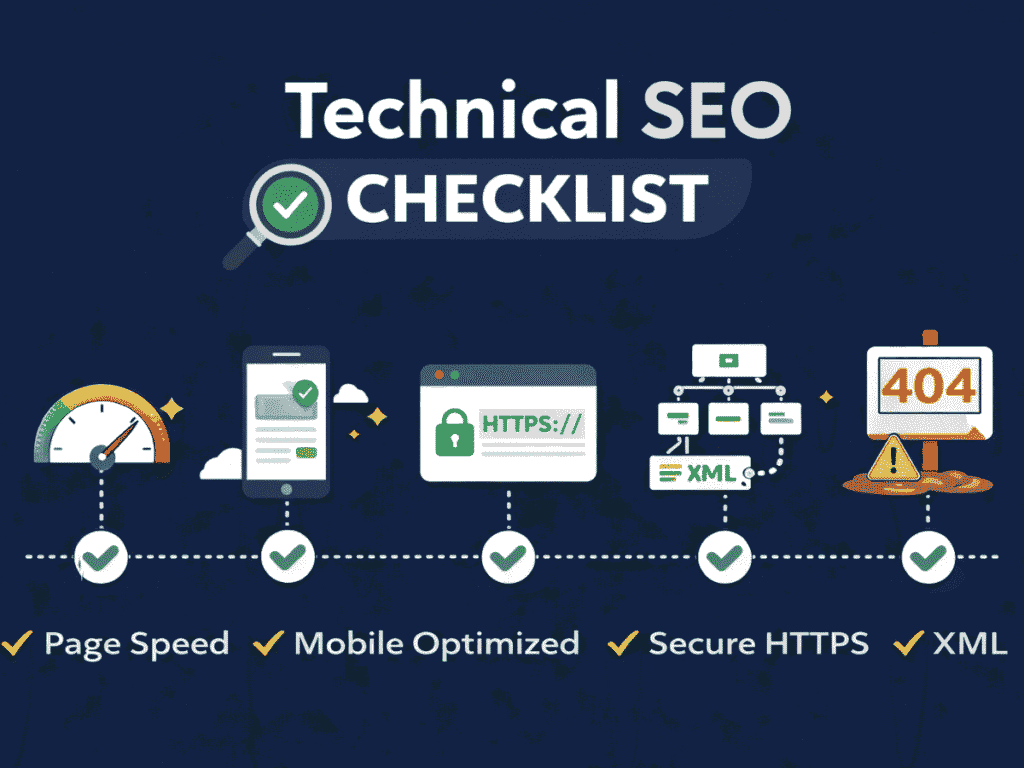
Technical SEO is the infrastructure layer of your website. No amount of high-quality content will generate rankings if Googlebot cannot efficiently crawl, render, and index your pages. The technical component is therefore the most critical section of the complete SEO audit checklist.
4.1 Crawlability and Indexation
Begin by auditing your robots.txt file to confirm you are not accidentally blocking critical resources CSS, JavaScript files, and key page templates must be crawlable for Google to render your pages correctly. Next, verify your XML sitemap is up-to-date, submitted to Google Search Console, and contains only canonical, indexable URLs.
Use Google Search Console’s Coverage report to identify pages with indexation errors: 404s, soft 404s, server errors (5xx), redirect chains, and pages blocked by noindex directives. Each category requires a different remediation approach 404s may need 301 redirects or content restoration, while noindex tags on critical pages need to be removed immediately.
4.2 Core Web Vitals and Page Speed
Core Web Vitals Largest Contentful Paint (LCP), Interaction to Next Paint (INP), and Cumulative Layout Shift (CLS) are confirmed Google ranking factors. Use Google Search Console’s Core Web Vitals report and PageSpeed Insights to measure field data (real-user metrics) for both mobile and desktop. Key thresholds to meet:
- LCP: under 2.5 seconds (measures loading performance)
- INP: under 200 milliseconds (measures interactivity responsiveness)
- CLS: under 0.1 (measures visual stability)
Common LCP fixes include optimizing image formats (WebP/AVIF), implementing lazy loading below the fold, enabling server-side caching, and using a CDN. CLS issues typically stem from unsized image and video elements or dynamically injected content that shifts the layout.
4.3 Mobile-First Indexing
Google now uses the mobile version of your site as the primary basis for indexing and ranking. Your technical SEO checklist must include a full mobile audit: verify font sizes are legible without zooming, tap targets are at least 48×48 pixels, content is not wider than the screen, and all resources visible on desktop are also accessible on mobile.
4.4 HTTPS, Canonical Tags, and Structured Data
Confirm your site is fully migrated to HTTPS with no mixed content warnings. Audit canonical tags across all pages to prevent duplicate content diluting link equity. Implement structured data (schema markup) for your key content types Article, FAQPage, BreadcrumbList, LocalBusiness and validate using Google’s Rich Results Test.
5. Step 3 On-Page SEO Audit
On-page SEO Audit covers every optimization element within the HTML of individual pages. This section of your website SEO audit should be executed page-by-page for your highest-traffic and highest-priority URLs.
5.1 Title Tags and Meta Descriptions
Title tags should be 50–60 characters, include the primary keyword near the start, and be unique across every page on the site. Duplicate title tags create indexing ambiguity. Meta descriptions (150–160 characters) do not directly influence rankings but significantly affect click-through rates write them as value propositions that include the primary keyword and a clear call to action.
5.2 Header Tag Hierarchy
Each page should have exactly one H1 tag containing the primary keyword. H2 tags should define major content sections and incorporate secondary keywords naturally. H3 tags subdivide H2 sections. A broken or absent heading hierarchy makes it harder for crawlers to understand content structure and reduces the effectiveness of your keyword targeting.
5.3 Internal Linking
Internal links distribute PageRank (link equity) across your site and establish topical authority clusters. Audit your internal link structure to ensure high-value pages receive links from multiple relevant pages. Use descriptive, keyword-rich anchor text avoid generic anchors like ‘click here.’ Also verify there are no orphan pages (pages with zero internal links pointing to them), as these receive no crawl priority.
6. Step 4 Website Structure and UX Audit
User experience signals engagement rate, dwell time, pages per session, and bounce rate indirectly influence rankings by indicating whether users find your content valuable. Google’s Helpful Content system specifically rewards sites where users consistently engage with and return to.
Audit your site architecture for depth: key pages should be reachable within three clicks from the homepage. Evaluate your navigation structure for clarity and logical hierarchy. Test your site on multiple device types and screen sizes. Core conversion paths contact forms, product pages, CTAs must be frictionless and fast-loading.
Accessibility also plays an increasingly important role. Ensure images have descriptive alt text, color contrast ratios meet WCAG 2.1 standards, and interactive elements are keyboard-navigable. Accessible sites tend to rank better because they serve a broader user base and generate fewer engagement-quality signals.
7. Step 5 Backlink Audit
Your backlink profile is one of the strongest authority signals Google evaluates. A high volume of low-quality or spammy backlinks can trigger a manual penalty or algorithmic demotion. The backlink section of your SEO audit checklist analysis checklist requires specialized tools Ahrefs, Semrush, or Majestic to conduct a full link audit.
7.1 Link Quality Assessment
Evaluate your backlink profile across these dimensions:
- Domain Rating (DR) and Domain Authority (DA) of referring domains
- Relevance of the linking domain to your industry
- Anchor text distribution over-optimized anchors are a spam signal
- Link velocity sudden spikes in link acquisition can trigger algorithmic scrutiny
- Ratio of follow to nofollow links
7.2 Toxic Link Remediation
Flag links from link farms, PBNs (Private Blog Networks), irrelevant foreign directories, or sites with zero organic traffic. Attempt outreach to remove them directly. For links that cannot be removed, compile a disavow file and submit it via Google Search Console. Only disavow at the domain level when you have clear evidence of large-scale spam.
8. Step 6 Local SEO Audit
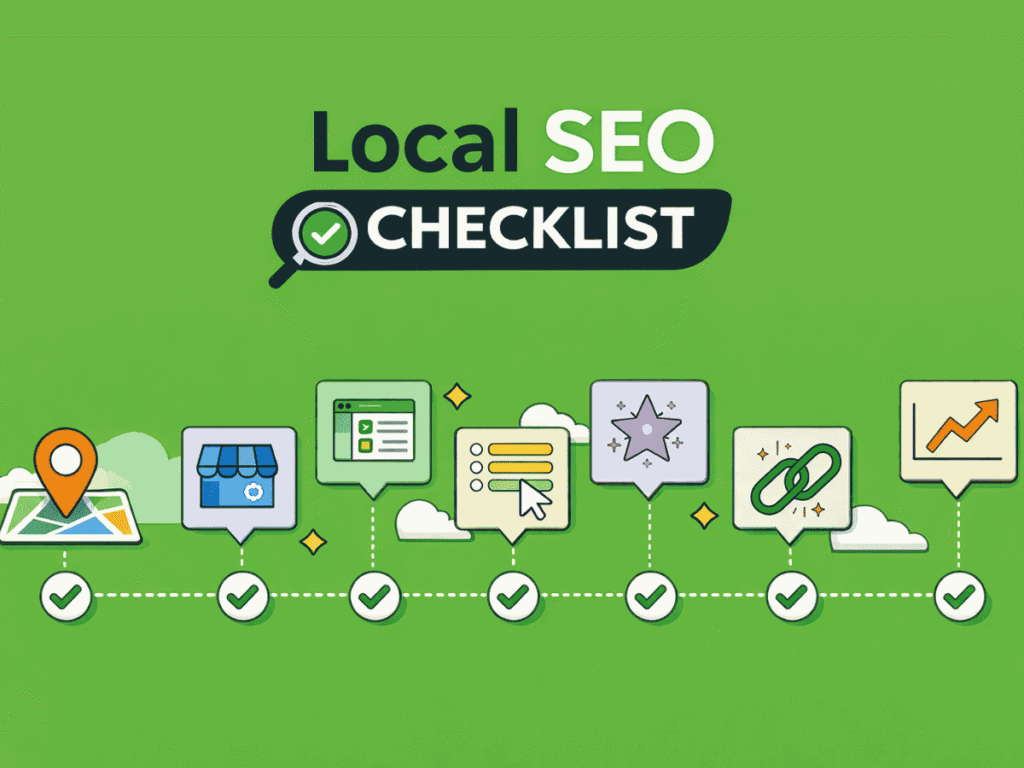
For businesses with a physical presence or geographic service area, a local SEO audit checklist is a distinct and critical workstream. Local ranking factors differ meaningfully from organic ranking factors.
- Google Business Profile: Verify all business information is accurate name, address, phone, website, hours, and categories. Add high-quality photos, respond to all reviews, and publish regular posts to signal active management.
- NAP Consistency: Your Name, Address, and Phone number must be identical across your website, Google Business Profile, and all local citations (Yelp, Justdial, Sulekha, industry directories). Inconsistencies confuse Google’s local entity resolution and suppress local rankings.
- Local Keywords: Integrate geo-modified keywords (e.g., ‘SEO audit services in Chennai’) into your page titles, headings, and content. Create dedicated landing pages for each service area if you serve multiple locations.
- Review Signals: Volume, recency, and sentiment of Google reviews are direct local ranking factors. Implement a review acquisition process and respond professionally to negative reviews.
9. Step 7 Content Quality Audit
Content quality is evaluated by Google across multiple dimensions beyond simple keyword usage. The SEO performance audit for content must assess whether your pages genuinely serve user intent better than competing results.
Conduct a content inventory by exporting all indexed URLs and their associated organic traffic data. Segment pages into three groups: high-performers (protect and update regularly), medium-performers (optimize and expand), and low-performers (consolidate, redirect, or remove). Pages with near-zero organic traffic and no strategic value dilute your site’s overall quality signal a concept known as crawl budget optimization.
For each priority page, evaluate: word count relative to top-ranking competitors, presence of supporting media (images, video, infographics), inclusion of FAQ sections targeting long-tail queries, readability score, and freshness of statistics and references. Outdated content pages referencing 2020 data on a topic that has evolved significantly should be updated with a revised publication date to recover ranking potential.
10. Step 8 Performance and Analytics Audit
Data integrity is a prerequisite for all SEO decision-making. Before analyzing performance metrics, verify that your analytics implementation is correct. Confirm Google Analytics 4 (GA4) is properly configured with no duplicate tracking, that conversion events are firing accurately, and that Google Search Console is linked to GA4 for integrated search performance data.
Key metrics to analyze in your SEO performance audit include:
- Organic sessions by landing page identifies which pages drive the most traffic
- Impressions vs. clicks (CTR) by keyword low CTR on high-impression keywords signals title tag or meta description optimization opportunities
- Average position trends track whether rankings are improving, stable, or declining post-algorithm updates
- Engagement rate and session duration low engagement on high-traffic pages indicates content-intent mismatch
- Crawl stats in Search Console monitors server response times and crawl anomalies
Establish a monthly performance reporting cadence and maintain a historical record of ranking changes, algorithm updates, and on-site changes. Correlating these events is essential for diagnosing ranking fluctuations accurately.
11. Step 9 — Competitor Analysis
Competitor analysis within your SEO audit Checklist guide serves two purposes: benchmarking your current position relative to the market and identifying specific tactical opportunities your competitors have exploited that you have not.
Identify your top three to five organic search competitors not just direct business competitors, but the sites that rank for the keywords you are targeting. Analyze their content depth, internal linking architecture, backlink acquisition strategies, and technical SEO Checklist implementation. Tools like Ahrefs’ Content Gap and Semrush’s Keyword Gap tools allow you to identify keywords your competitors rank for that you do not these represent immediate content creation or optimization opportunities.
Also audit competitor page structure, schema markup usage, and Core Web Vitals scores. If a competitor consistently outranks you despite having fewer backlinks, the differentiator is likely content quality, topical authority depth, or technical page experience signals.
12. Step 10 Continuous Optimization
A one-time SEO audit Checklist produces a snapshot. Sustained ranking improvement requires a continuous optimization cycle. After completing your initial audit, build a prioritized issue backlog organized by impact and implementation effort. Address critical technical issues first (crawlability, indexation, Core Web Vitals), then on-page optimizations, then content improvements, and finally link acquisition campaigns.
Re-run your complete SEO audit checklist quarterly to track remediation progress and catch new issues introduced by site updates, CMS migrations, or algorithm changes. Monthly monitoring should cover Core Web Vitals scores, Search Console coverage errors, ranking position changes for target keywords, and backlink profile health.
Integrate SEO audit checklist outputs directly into your content calendar and development sprint planning. SEO cannot operate as a siloed function it must be embedded into every content publication, design update, and technical deployment decision. Sites that treat SEO as a continuous practice rather than a periodic fix consistently outperform those that do not.
13. Final SEO Audit Checklist Summary
Below is a complete, consolidated reference of every major action item from this SEO audit checklist:
- Keyword mapping: align pages to search intent, fill content gaps, optimize placement in title, H1, and body
- Technical crawlability: fix robots.txt blocks, update XML sitemap, resolve indexation errors in Search Console
- Core Web Vitals: achieve LCP under 2.5s, INP under 200ms, CLS under 0.1 on mobile and desktop
- Mobile-first: audit tap targets, font sizes, viewport configuration, and mobile content parity
- HTTPS and canonicalization: enforce SSL, audit canonical tags, eliminate duplicate content
- Structured data: implement and validate schema markup for all relevant content types
- On-page elements: unique title tags, single H1, logical H2/H3 hierarchy, descriptive meta descriptions
- Internal linking: eliminate orphan pages, use keyword-rich anchor text, build topical authority clusters
- Backlink audit: assess link quality, disavow toxic links, build links from high-DR relevant domains
- Local SEO: optimize Google Business Profile, enforce NAP consistency, build local citations, acquire reviews
- Content audit: remove or consolidate thin pages, expand top performers, update outdated statistics
- Analytics integrity: verify GA4 setup, link Search Console, track conversions and engagement by landing page
- Competitor gap analysis: identify keyword and content gaps, benchmark technical and link metrics
- Continuous optimization: quarterly full audits, monthly monitoring, SEO integrated into all site processes
14. Conclusion
A rigorously executed SEO audit checklist is the most reliable method for diagnosing why your website is underperforming and identifying the highest-leverage actions to improve it. In 2026, with Google’s algorithm evaluating technical quality, content depth, user experience, and authority signals in concert, no single optimization tactic is sufficient on its own.
The step-by-step SEO audit checklist in this guide gives you a systematic, technically grounded process for assessing every ranking dimension from Core Web Vitals and schema markup to content E-E-A-T signals and local citation consistency. Executed regularly and acted on decisively, it becomes the operational engine of sustained organic growth.
The difference between sites that dominate search results and those that struggle is rarely talent or budget it is the discipline of structured, consistent auditing and optimization. This SEO audit checklist is your framework for building that discipline.
15. Call to Action
If you want expert help executing your SEO audit checklist including technical site crawls, keyword gap analysis, Core Web Vitals optimization, and local SEO audits partner with Visibiliti Digital Marketing. Our team delivers data-driven SEO audits that translate directly into measurable ranking improvements and organic traffic growth. Take your business to the next level today.